
Mole Removal: Your Questions Answered
Medically Reviewed By: Kelli Bryant, MD
Moles, also called nevi, are sometimes considered beauty marks. But if you have a mole — especially a facial mole — that’s more of an eyesore, or if a mole is easily irritated by clothing or gets snagged on jewelry, chances are you’d rather be rid of it.
Can you remove moles? The answer is often yes. For many moles, mole removal at your dermatologist’s office is an option.
Here, Kelli Bryant, MD, a board-certified dermatologist at Water’s Edge Dermatology, answers common questions about mole removal and explains why you shouldn’t attempt it at home.
Do moles have to be removed?
In most cases, whether or not to remove a mole is entirely up to you. But if the mole shows signs of skin cancer, your dermatologist may have to remove it. Suspicious (atypical) moles are identified using the ABCDE rules:
- A for Asymmetry. One part of the mole doesn’t look like the rest of it.
- B for Border. The border of the mole is irregular or poorly defined.
- C for Color. The mole is multi-colored. You may see shades of tan, brown or black along with red, white or blue areas.
- D for Diameter. The mole is larger than 6 millimeters, which is about the size of a pencil eraser.
- E for Evolving. The mole is changing in shape, size or color.
Do atypical moles need to be removed? Not necessarily. “Many benign moles break the ABCDE rules,” Dr. Bryant said. Still, you should have any suspicious mole evaluated by a skin care provider, who may biopsy it to check for cancer.
Is there an effective way to remove moles at home?
At best, home remedies and over-the-counter mole removal tools are a waste of time and money. But in some cases, mole removal at home can be downright harmful.
“Some of the home remedies you see online, such as applying iodine or apple cider vinegar to the mole, can cause a lot of skin irritation, to the point that it’s almost like a chemical burn,” Dr. Bryant said.
Other purported DIY treatments, such as taping a banana peel or garlic clove to the mole, may not be as dangerous but are equally ineffective. What about using a mole removal cream or cauterizing (burning) the mole with a mole removal pen? Those approaches won’t make a mole disappear and may lead to scarring and pitting.
“If those products should happen to work, it’s because the ‘mole’ was actually a different type of skin growth, such as a seborrheic keratosis,” Dr. Bryant said.
Never attempt to remove a mole with a razor blade or scissors. The risk of infection and scarring is far higher than if you have a mole removed professionally. Cutting off a mole at its base with a razor blade can cause profuse bleeding. Also, the risk of mole recurrence after removal is higher if you try to slice off the mole yourself, simply because you probably won’t get it all.
Even if any of these approaches did work, it’s still a bad idea to remove a mole yourself, Dr. Bryant said. “Any mole, no matter how benign it looks, could be malignant, so you should always see a dermatologist to have it evaluated and removed safely.”
How do dermatologists remove moles?
Water’s Edge Dermatology providers offer two mole removal options: shave excision and punch biopsy. Laser mole removal is not an effective method.
Shave excision for raised moles and large moles
Shave excision is the most commonly used mole removal technique and is typically recommended for raised or large moles. The provider injects the treatment area with a local anesthetic, then shaves off the mole with a surgical blade.
Shave excisions can be superficial or deep. If the mole is benign, it’s cut down to the level of the surrounding skin. But if the mole looks suspicious, the dermatologist will likely perform a deep shave excision, or saucerization biopsy. In this case, a curved blade is used to remove the mole and layers of tissue beneath it so they can be checked for cancer cells. Stitches usually aren’t needed to close superficial excisions, but they are often needed for deep ones.
If your mole is very large, you may choose to have it removed by a plastic surgeon rather than a dermatologist in case any reconstruction work is necessary.
Punch biopsy for small moles, flat moles and penetrating moles
For moles that are small, flat or penetrate deeper into the skin, your skin care provider may recommend a punch biopsy.
After injecting an anesthetic, the provider inserts a pen-like instrument into the skin under the mole. The instrument has a sharp end that looks like a tiny round cookie cutter. The device is rotated until the end cuts through the epidermis and dermis and into the fat below. Next, the mole and the plug of tissue beneath it is pulled from the skin with forceps and snipped away with surgical scissors. The area is closed with a few stitches.
Will I have a scar after mole removal?
Removing a mole always creates a scar, regardless of the technique used, Dr. Bryant said. You may be left with an area that’s lighter than the surrounding skin (a hypopigmented scar) or a line that can be either paler or darker than your skin tone.
Some people have an exaggerated scar response to mole removal in which thick, hypertrophic (raised) scars or keloids form. Hypertrophic scars and keloids are somewhat similar, but unlike hypertrophic scars, keloids can extend beyond the treated area.
“If you have a history of keloid scars, it might be better to leave the mole alone,” Dr. Bryant said. Your dermatologist will discuss the risks and benefits of mole removal to help you decide if you want to proceed.
If a mole removal scar does develop, scar treatments are available that can lessen their appearance, such as pulsed dye laser treatments to remove redness and flatten raised scars and cortisone injections to soften firm scars.
Can a removed mole grow back after being removed?
Mole regrowth is possible, particularly if the mole was raised. The reason: “There are almost always some mole cells left behind when you remove a mole,” Dr. Bryant said.
Your dermatologist can try to remove the mole again if it regrows, but you may find that the regrown mole doesn’t bother you as much as the original. “When a raised mole returns, it usually doesn’t grow back to its original height, so it may be less noticeable,” said Dr. Bryant explained.
Make an appointment to discuss mole removal with a Water’s Edge Dermatology provider.
Article Written By: Jessica Brown, a health and science writer/editor based in Nanuet, New York. She has written for Prevention magazine, jnj.com, BCRF.org, and many other outlets.
When to See a Dermatologist for a Mole
Skin Moles are common. Almost everyone has a few, and some people develop hundreds. And melanoma, the deadliest type of skin cancer, can develop in or near moles.
Don’t get frightened—most skin moles are not melanoma. So how do you know when to see a dermatologist for your moles? It’s easy; just keep in mind your ABCs.
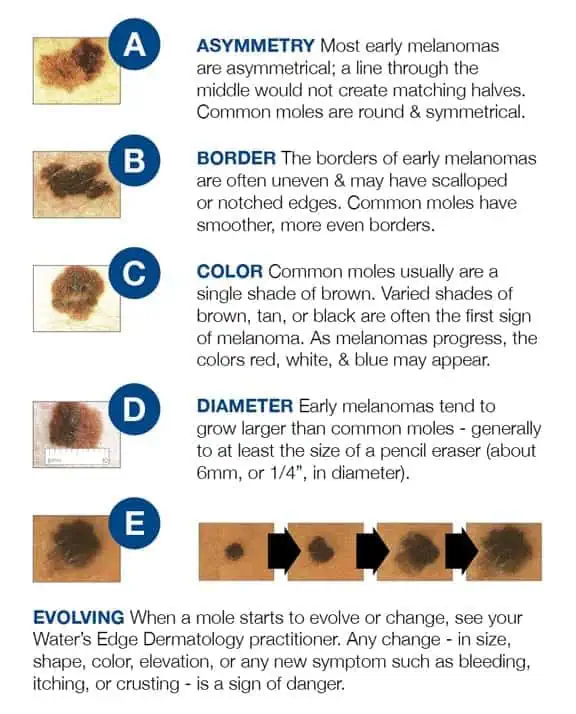
A stands for ASYMMETRY: If one half of the mole is unlike the other half, have it looked at.
B stands for BORDER: If your mole has an irregular, scalloped or poorly defined border, it could be an early melanoma. Only a biopsy can provide conclusive results.
C stands for COLOR: If a mole’s color varies from one area to another, or if it turns shades of tan, brown and black (opposed to brown, which is normal), call your dermatologist.
D stands for DIAMETER: Melanomas are usually greater than 6mm (the size of a pencil eraser) when diagnosed, but they can be smaller. If a mole is large, have it examined and stay very aware of changes or growth.
E stands for EVOLVING: A mole or skin lesion that looks different from the rest or is changing in size, shape or color could be a sign of early skin cancer.
If you have a mole that shows any of these signs, be sure to schedule an appointment with a Water’s Edge Dermatology provider today. If something doesn’t seem right, or keeps grabbing your attention, come see us.