






What Does Lip Cancer Look Like?
Medical Review By: Thomas Pham, MD
Your lips are important for lots of things, including chewing and kissing. While the occasional cold sore or cause of chapped lips is annoying, lip cancer is another story entirely.
Lip cancer in its early stages is hard to notice, but that’s when it’s most treatable. By the time a lip tumor becomes obvious, cancer requires more invasive treatment, and it may spread to other parts of your body.
If you get a lot of sun exposure, or you smoke, chew tobacco, or drink heavily, it’s time to learn how to spot it.
Types of lip cancer
Lip cancer usually takes the form of squamous cell carcinoma. This type of cancer occurs in the squamous cells, which are thin, flat cells found in the middle and outer layers of the skin. Squamous cell cancer of the lip is much more aggressive than squamous cell cancer found in other places of the skin. It’s more likely to spread to the head and neck and harder to treat.
Much less frequently, lip cancer is melanoma, one of the deadliest types of cancer.
Lip cancer symptoms
The lower lip is more vulnerable to lip cancer because it gets more sun exposure than the upper lip. Symptoms to watch for include:
- A sore, ulcer or lesion on your lip that doesn’t heal (a cold sore, unlike lip cancer, does heal)
- A lump or thickened area on the lip
- Whitish or reddish patches on the lip
- Lip pain, bleeding or numbness
- A lump in your neck or swollen glands
- Jaw swelling or tightness
A precancerous condition that can lead to squamous cell cancer of the lip is actinic cheilitis. Symptoms include:
- Scaly whitish patches on the lip
- Dryness or peeling that won’t heal
- A rough, sandpapery texture
- Blurring of the border between the lip and the adjacent skin
- Loss of color in the skin of the lip
- Swelling or redness of the lip
Who gets lip cancer?
UV radiation from spending a lot of time in the sun or using tanning beds is the leading cause of lip cancer. Certain habits, such as smoking or chewing tobacco and excessive drinking, also increase the risk.
Other risk factors for lip cancer include having a weakened immune system, having fair skin, being over 40 years old, and being infected with certain strains of human papillomavirus (particularly strains 16 and 18). Lip cancer is more common in men, possibly because they are more likely to work outdoors and less likely to use lip balm with SPF. They may also be more likely to have smoked or consumed too much alcohol in the past.
Recent research suggests that taking hydrochlorothiazide, a diuretic, is strongly associated with an increased risk of developing lip cancer. This drug is used alone or in combination with other medications to treat high blood pressure.
Lip cancer treatment
Lip cancer is usually curable; most people survive it and have a good outcome after treatment.
The doctor may recommend Mohs surgery to remove the tumor. In this procedure, the surgeon gradually removes layers of the tumor and a small amount of tissue surrounding it, checking each layer for cancer cells. The surgery ends when cancer cells can no longer be detected under a microscope. Mohs surgery lets surgeons identify and remove tiny roots of cancer, which helps prevent it from spreading to other parts of the body.
Advanced cases are usually treated by an ear, nose, and throat doctor (ENT). Radiation and/or chemotherapy may be used in conjunction with surgery. In rare cases, radiation “seed” therapy is used to treat patients who opt out of surgery. Reconstructive surgery may be necessary to repair the lip.
Protect your lips by following these tips:
Wear lip balm with SPF. Choose a lip balm with an SPF of at least 30 and wear it whenever you go outside. A wide-brimmed hat is also a good idea.
Don’t use tanning beds. Indoor tanning isn’t any safer for your skin than lying in the sun.
Limit or quit smoking and drinking. This is especially important if you drink and also smoke. These habits together put you at much higher risk for lip cancer than either habit alone.
See your dentist regularly. Dentists are often the ones to detect lip cancer, so keep up with routine cleanings and exams.
If you notice any unusual changes in your lip when you look in the mirror, don’t panic. But if something looks or feels different and the problem doesn’t resolve quickly, call your dermatologist ASAP. Treating lip cancer early means less risk of spoiling your smile.
Article Written By: Jessica Brown, a health and science writer/editor based in Brooklyn, New York. She has written for Prevention magazine, jnj.com, BCRF.org, and many other outlets.
Foot Melanoma: The Hidden Skin Cancer It Pays to Watch For
Medical Review By: Ted Schiff, MD
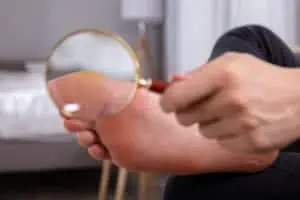
When you examine your feet, you’re probably more concerned about dry heels or nail problems than melanoma. After all, melanoma usually occurs in parts of the body that get a lot of sun exposure.
But foot melanoma — the skin cancer that killed reggae star Bob Marley — is real. And because they’re not looking for it, most people notice it too late, when it has already spread to other organs.
Foot melanoma can occur anywhere on the foot, including the top and bottom, between the toes, and even under a toenail. It can arise from an existing mole or from clear skin. It can strike any age group and is equally common in African Americans and Caucasians. For people of African or Asian descent, the feet and hands are the most common places for melanoma to develop.
No matter your skin color or age, the message is the same: Check your feet for melanoma.
What to look for
The signs are different depending on the type of foot melanoma, but be on the lookout for:
- A spot or growth that may be pinkish-red, brown, black, blue, white or some combination of these colors
- A new spot or growth that appears where you have injured your foot
- A sore that is slow to heal, does not heal or keeps coming back
- Pigment that spreads from a growth to the surrounding skin
- An open wound or sore that resembles a diabetic ulcer
- A dark vertical line under a toenail
Follow the ABCDE rule for evaluating skin spots and growths. Look for asymmetry (one side doesn’t match the other), an irregular border and changes in size, shape or color. A melanoma of the foot may feel tender, itch, ooze, bleed or become scaly.
Types of foot melanoma
Not all foot melanomas are the same. If you have foot melanoma, a dermatologist can determine which of these types it is:
Superficial spreading melanoma. This is the most common type of melanoma. When it affects the foot, it typically appears on the top. The spot or growth may be raised or flat and usually has an irregular shape. It may be tan, brown, black, red, blue, white or a combination of any of these colors. It gets larger before it penetrates deeper skin layers.
Acral lentiginous melanoma. This can develop on the sole of the foot or in the toenail bed. When it affects the sole, it looks like a flat, black or brown discoloration that gets larger over time. It may resemble a bruise or stain. When it develops in the bed of the nail (this condition is called subungual melanoma), it appears as dark vertical streaks. Subungual melanoma can cause cracks or breaks in the nail as it progresses.
Nodular melanoma. Nodular melanoma usually appears as a round bump or nodule. It’s usually black but can also be blue, gray, red or white. It may even be the same color as your skin. It spreads quickly. While anyone can develop nodular melanoma, it’s more common in people with light skin who are over the age of 65.
Amelanotic melanoma. This a rare form of melanoma. It appears as a raised growth that is often skin-colored, which makes it hard to detect. The growth may also be red or pink. The best way to spot it is to look for any raised growth that is new or has changed. Risk factors include having red hair, pale and/or sun-sensitive skin, freckles and a lack of moles on your back.
Foot Melanoma Treatment
Your doctor will recommend a treatment based on your overall health and the stage of your skin cancer.
If the melanoma is caught early, the doctor may be able to cut out (excise) the growth and surrounding skin during an office visit. If the melanoma is advanced, it may require chemotherapy, radiation therapy, and/or immunotherapy. If cancer has spread to the lymph nodes, the nodes may need to be removed.
The best way to avoid more invasive treatment is to notice the signs of foot melanoma as soon as possible and see your dermatologist right away.
Article Written By: Jessica Brown, a health and science writer/editor based in Brooklyn, New York. She has written for Prevention magazine, jnj.com, BCRF.org and many other outlets.
Medical Review By: Ted Schiff, MD