






Top 5 Tips for Fighting Toenail Fungus

Getting rid of a toenail fungal infection can be tough and it can take up to a year to achieve completely clear nails. A toenail fungus infection usually begins with swollen skin or pain around your nail, and you may notice dents, ridges or lines in your nails.

Your medical dermatologist will examine your nails and determine a treatment plan to help clear your toenail fungus. Here are five tips you can use to make your treatment plan even more effective:

  1. Keep your nails trimmed and filed to make sure you remove any fungus build up on your toenails. This helps keep the fungus from spreading.
  2. Follow your treatment plan. Missing oral treatments or skipping topical treatments prevent your treatment from working as well as it could.
  3. Ask your dermatologist if a nail lacquer, such as Penlac®, can help keep your toenail fungus infection from spreading. These nail lacquer treatments alone do not always clear infections, but they can aid your treatment plan.
  4. Keep your feet clean and dry to ensure the condition of your feet does not encourage fungal growth.
  5. Take steps to prevent future toenail fungus infections. In cases when patients do not continue to take steps for prevention, the nail fungus can return, according to the National Institute of Health.

If you are concerned you may have a toenail fungus infection, make an appointment with your Water’s Edge medical dermatologist today. He or she will take a culture of your nail and determine the best course of treatment for you. At Water’s Edge Dermatology, we have serious medicine for your skin.


Adult Dermatology: Changes in Aging Skin

We won’t stay young forever, but that doesn’t mean our skin can’t continue to look its best. Adult skin changes as it ages, and some of these changes are more obvious than others. The trick to keeping your skin looking healthy and young for longer is prevention. Your Water’s Edge adult dermatologist can help you stall some of the side effects of age. Here are the five most-common effects of aging skin:

  1. Skin gets drier. Your skin produces fewer moisturizing oils as you age, so it’s important to protect your skin from losing moisture to wind, hot baths or the sun.
  2. Your skin begins to thin. Adult skin thins as you lose some of the fatty layer below your skin. Your skin cells regenerate more slowly and your collagen and elastin levels decrease as you age.
  3. Skin begins to sag. As your skin thins and you experience lymphatic drainage, gravity begins to pull on your skin. The decreasing levels of collagen and estrogen mean there is less structure for your skin as well.
  4. Age spots develop on exposed skin. Age spots are areas approximately the size of freckles. They are caused by melanin overproduction due to sun exposure.
  5. Wrinkles form and deepen. The most common causes of wrinkles are sun exposure, muscle and skin movement from facial expressions, slower skin cell regeneration and less collagen production. These are made more prominent by sagging skin.

Your skin is an indicator of your health, so keep it looking as good as you feel. Your adult dermatologist can treat dry and sagging skin, wrinkles and age spots. Make your appointment with a Water’s Edge dermatologist today and get serious medicine for your skin.


Adult Acne Treatment

Treating Adult Acne

Acne is frequently considered a skin disorder of adolescents and teens. Unfortunately, acne can affect adults in their 20s, 30s and beyond. Many factors can contribute to the appearance of acne, including hormones, disorders of the hair follicles and infections. While there is no cure for acne, there are many effective ways to control and treat adult acne.

Adult acne can be divided in two groups of patients. The common acne in children can also occur in an adult, which is known as acne vulgaris. Another form of adult acne is known as acne rosacea. Acne rosacea is commonly recognized by the inflammation and redness of the face, but most often lacks the appearance of blackheads or open comedones.

Acne can be controlled with over-the-counter products as well as prescription medications. Establishing a skin care regimen with a dermatology provider can be very helpful in treating acne. Many treatments are available, including cleansers, topical treatment, oral antibiotic therapy, oral isotretinoin courses and even blue light therapy.

Starting with a mild antibacterial cleanser or benzoyl peroxide wash twice daily keeps the face and body clean and keeps oil to a minimum. Do not scrub the face and body clean as friction can increase the acne lesions.

Prescription treatments available for acne can be topical creams, gels or solutions. The topical medications can include one or more medications. Topical medications should be used consistently and as prescribed by your provider for best results. Topical treatments can be drying, so it is important to speak with your provider about adding a moisturizer or decreasing the frequency of use if this occurs.

Oral antibiotics can be used to treat acne and acne rosacea in adult patients. Oral antibiotic therapy can be given for short-term or long-term treatments, depending on the response to treatment and the medication prescribed by your provider. Low dose, long-term antibiotic therapy is available and effective for many patients.

Oral Isotretinoin is an option for severe acne. It was previously marketed under the name Accutane but is available now in generic forms. This particular medication is available if other oral medications have failed. Isotretinoin is closely monitored by a program called iPledge. Blood work is monitored each month by your provider. Two forms of birth control must be in place for female patients as this medication can cause birth defects if pregnancy occurs during the time period the medication is being administered. This medication is generally given for a course of four to six months.

The most important key to the management of acne is to be consistent with your use of medication. Consistency is important.

Finally, even acne prone skin needs sunscreen each day. Finding a sunscreen that is oil-free and non-comedogenic is important. Please visit a Water’s Edge office for Elta MD Shield, which is a zinc sunscreen that is lightweight, absorbs completely and is great for oily skin types.

References: Acne (n.d.) American Osteopathic College of Dermatology. Retrieved from www.aocd.org.


Top 5 Reasons to Consider Juvederm Voluma

Some signs of aging can begin to appear when women are in their mid-30s, such as cheeks losing volume or deepening under-eye circles. Fortunately, there are several ways to keep aging skin from detracting from your natural beauty, such as fillers like Juvederm Voluma. Here are the five top reasons why you should consider Juvederm Voluma when you decide to get a filler treatment.

  1. Restores fullness to your face by filling both fine and deep lines for a natural appearance.
  2. Diminishes any scars you may have accumulated over the years.
  3. Produces immediate results, meaning your face looks as youthful as you feel by the time you leave the office, and no downtime is required.
  4. Treatment is completed in one visit, so you don’t have to worry about scheduling multiple appointments.
  5. Results last for months, and when you combine certain fillers, your results can last between three months to a full year.

Juvederm is a smooth gel made from hyaluronic acid, which occurs in your skin naturally. Your Water’s Edge adult dermatologist can use the combination of Juvederm Voluma to smooth your skin and add volume and hydration. It is the latest facial filler option available and it is the only filler approved by the U.S. Food and Drug Administration.

Make an appointment with your Water’s Edge Dermatologist for a consultation about your filler treatment today. You can like us on Facebook to find more tips about skin care and our serious medicine for your skin.


Dermatologist examining a mole on a patient's skin.

Top Reasons to See a Professional for Mole Removal
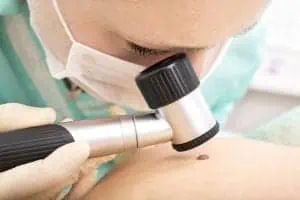
Moles are removed for several reasons, whether medical or cosmetic. If you find your skin mole unattractive, it causes irritation from rubbing against clothing or your dermatologist suspects cancer, removing your mole, or moles, is an option.

There are several at-home and “natural” treatment options available, but these can cause complications if not performed correctly. Let’s talk about the top five reasons to have your skin mole treatment performed by your dermatologist.

  1. If your mole might be cancerous, or pre-cancerous, your dermatologist can help you begin treatments to prevent the spread of skin cancer. A dermatologist can have a sample of your mole tested when removing it, which cannot be done with at-home treatments.
  2. Your mole could grow back. Shaving or treating your skin mole at home may not completely remove the mole. If your mole does grow back, that is a possible sign of melanoma, for which you should be treated by a dermatologist.
  3. You could disfigure your skin by leaving scars. Especially on the face, it is important to have moles treated properly to avoid unnecessary scarring.
  4. The treatment site could get infected. A dermatologist can prevent infection from occurring by correctly preparing your skin for the mole treatment and by properly treating and closing the wound.
  5. Mole removal creams can leave pits in your skin. Some skin mole removal creams are corrosive and can cause damage to healthy skin if used incorrectly. If you want to try this method, it is recommended you discuss it with your dermatologist to minimize potential side effects.

Your Water’s Edge dermatologist can effectively remove your skin moles with one of two skin mole treatments: surgical excision or surgical shaving, both of which can be performed in-office. Make an appointment to discuss your skin mole treatment with your Water’s Edge dermatologist.


How to Give Yourself a Skin Mole Exam

You frequently hear dermatologists and skin cancer experts talk about the importance of regularly examining your skin, but do you know the best way to check yourself? Your skin moles should remain fairly constant, but here are the steps to find any new or changed moles.

Skin Mole Self-Examination:

  1. Start with your face, ears, scalp and neck. Use a hand mirror to see the back of your neck and a comb to part your hair to make this easier. Or, ask friend to help check your scalp.
  2. Stand in front of the mirror and look at the front and back of your body. Remember to raise your arms to look at your sides.
  3. Next, look at your hands and arms. Carefully examine your fingernails, palms and elbows, and look at your arms from all directions.
  4. Look at your legs from all angles using your mirror. Remember to check swimsuit areas for moles as well.
  5. Sit down and examine the bottoms and tops of your feet, your toenails and the spaces between your toes.
  6. Finally, take notes about your skin’s appearance and mark the dates of your skin mole exam. This will help you identify changes in your moles in the future.

Most of the moles you find likely developed when you were young, and you will continue developing skin moles until the age of 40. Most moles are harmless, but checking your skin regularly will help you track any changes and alert you to seek mole treatment if necessary.

If you find any suspicious or new moles, make an appointment with your Water’s Edge dermatologist to learn if you need skin mole treatment.


mohs skin cancer treatment

Skin Cancer Screenings for Skin Cancer Month
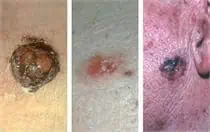
According to the American Cancer Society, skin cancer accounts for nearly half of all cancers in the United States, with one in five people having some form of skin cancer. Melanoma, the most serious type of skin cancer, will account for more than 76,600 cases of skin cancer in 2013, resulting in roughly 9,000 deaths annually.

“It’s so unfortunate when a patient waits too long to be screened and melanoma is found way too late, as it’s very treatable if found early,” says Justin Platzer, M.D., a board-certified dermatologist and Mohs skin cancer surgeon at Water’s Edge Dermatology.

Darlene Moore of West Palm Beach, Fla., echoes Dr. Platzer’s sentiment of the importance of diagnosing melanoma early. During a regular skin cancer screening at Water’s Edge Dermatology, Shanna Stone, ARNP, saw a few areas of concern on Ms. Moore’s ear and arm and took biopsies. Ms. Moore was diagnosed with Stage 1 melanoma on her arm and basal cell carcinoma on her ear.

“The basal cell, frankly, I wasn’t as concerned about,” says Ms. Moore. “Dr. Platzer reassured me that Mohs surgery was very effective for basal cell carcinoma and he was able to get it all. But I was really concerned about melanoma, because my brother-in-law died of melanoma.”

Surgery is the best way to remove early melanomas, with later stages usually requiring more extensive treatment, such as radiation and chemotherapy. Mohs surgery saves the greatest amount of healthy tissue, appears to reduce the rate of local recurrence and has the highest overall cure rate — about 94 percent to 99 percent — of any treatment for squamous cell carcinoma. And generally, Mohs surgery is 98 percent or better for basal cell carcinoma, according to the Skin Cancer Foundation.

“As the old saying goes, ‘An ounce of prevention is worth a pound of cure,’” says Dr. Platzer.  “Say no to tanning beds and always wear sunscreen. And, if you live in sunny Florida, it is critical to have regular skin cancer screenings — and there’s no better time than this month, Skin Cancer Month.”

Many of Water’s Edge Dermatology clinics are open Saturdays and late during the workweek. To make an appointment, visit www.WeDerm.com and fill out the online appointment form, email info@WeDerm.com or call (561) 694-9493 for more information.


Skin Cancer Prevention Tips for Skin Cancer Awareness Month

May is Skin Cancer Awareness Month, and Water’s Edge Dermatology recommends the following skin cancer prevention tips to have fun in the sun and reduce risk for skin cancer at the same time:

  • Generously and regularly apply water-resistant sunscreen that has a sun protection factor (SPF) of 30 or more. Make sure the sunscreen is labeled as “broad-spectrum,” indicating it protects against ultraviolet A (UVA) and ultraviolet B (UVB) rays. Reapply sunscreen every two hours and after swimming or sweating—and use it year-round.
  • Use extra caution when taking sun-sensitizing medications or are near water, snow and sand. Some over-the-counter medications, such as ibuprofen, and prescription drugs, such as antibiotics, can make your skin more sensitive to sunlight. Water, snow and sand can reflect and/or intensify sun rays, making it easier to burn.
  • Wear protective clothing, including long-sleeved shirts and pants, a wide-brimmed hat that provides more coverage than a baseball hat and UVA/UVB protective sunglasses.
  • Seek shade during the middle of the day, between 10 a.m. and 4 p.m., when the sun’s rays are strongest, and try to schedule outdoor activities for other times of the day—even when it is cloudy.
  • Say no to tanning beds.  Ultraviolet light from tanning beds can cause skin cancer. New self-tanning lotions and spray booths provide a tan without the risk of cancer.
  • Check your entire body routinely and report skin changes to your dermatologist. New growths, changes in existing moles or bleeding on the skin, require an immediate appointment with a dermatologist. Skin cancer is very treatable when caught early.

“As the old saying goes, ‘An ounce of prevention is worth a pound of cure,’” says Dr. Platzer.  “Say no to tanning beds and always wear sunscreen. And, if you live in sunny Florida, it is critical to have regular skin cancer screenings—and there’s no better time than in May, skin cancer awareness month.”