





Woman eating oranges with an orange background behind her

How to Prevent Wrinkles While You Still Can

Medical review by Denise Guevara, DO

If your face is still as smooth as a baby’s bottom, you probably aren’t thinking about wrinkles. Unfortunately, everyone gets them eventually, partly because as the body ages, it produces less collagen and elastin, proteins that keep the skin firm and elastic.

But if you act now, you can delay the development of wrinkles and enjoy young-looking skin longer. Here, Denise Guevara, DO, a board-certified dermatologist at Water’s Edge Dermatology, shares her best tips for staving off these telltale signs of aging.

Use sunscreen daily

You probably know this, but it bears repeating: Wearing sunscreen is one of the best ways to prevent wrinkles.

“Exposure to the sun’s ultraviolet rays is one of the main causes of premature wrinkles because they damage collagen and elastin, among other harmful effects,” said Dr. Guevara.

Sunscreen plays a particularly large role in preventing wrinkles in people with fair skin. A study published in Clinical, Cosmetic, and Investigational Dermatology concluded that UV rays appeared to be responsible for 80% of signs of aging facial skin in Caucasian women. (The sun takes less of a toll on dark skin because the skin contains more melanin, which provides some natural protection.)

Regardless of skin color, everyone should wear a broad-spectrum sunscreen with an SPF of at least 30 every day, both to prevent wrinkles and to reduce the risk of skin cancer, Dr. Guevara noted.

RELATED: A Melanoma Warning for Millennials and Gen Z

Wear sunglasses

Wearing sunglasses protects the skin around your eyes from UV rays and guards against wrinkles by making you less likely to squint.

“Crow’s feet, which are the wrinkles that form at the outer corners of your eye, are dynamic wrinkles, meaning they develop as a result of repetitive facial movements such as squinting,” Dr. Guevara explained.

If you need regular prescription glasses, it’s important to wear those too in order to limit squinting. Be sure to get regular eye exams as well. You may not realize right away that your vision has gotten worse and that you’ve been squinting more than usual.

Quit smoking

Smoking and vaping cause premature facial wrinkling in several ways. They interfere with the body’s ability to produce collagen and cause blood vessels to narrow, which prevents nutrients from being delivered to the skin. Smoking is also a major contributor to dynamic wrinkles.

“When you smoke, you make repetitive facial movements, such as pursing your lips and squinting,” Dr. Guevara said. “Over time, this creates wrinkles around the mouth and eyes.”

Quitting smoking won’t reduce wrinkles that have already appeared, but it can prevent them from deepening.

Sleep on your back

If you regularly sleep on your side or stomach, you may develop more wrinkles than someone who sleeps on their back.

“Resting your face on a pillow creates compression, which reduces blood flow to the areas of your skin and neck that are in contact with the pillow, depriving them of nutrients,” said Dr. Guevara. “This causes wrinkles to develop on the affected areas as time goes by.”

Can’t sleep on your back? You can minimize compression by sleeping on a softer, bouncier pillow.

Use retinoids

These vitamins A derivatives are commonly used to reduce and prevent wrinkles by increasing collagen production.

“Retinoids are like insurance against future wrinkling,” Dr. Guevara said. “You can start using them in your 20s to prevent wrinkles, though some people begin applying them in their teens because retinoids are also an effective treatment for acne.”

Your dermatologist can prescribe a retinoid, or you can use an over-the-counter retinol product. Retinols are weaker versions of retinoids. The option you choose comes down to what your skin can tolerate. Retinoids are very exfoliating, so you may prefer retinol — and lower-concentration retinol at that — if you have sensitive skin.

Apply a moisturizer that contains hyaluronic acid

Almost any moisturizer can temporarily plump the skin and diminish the appearance of fine lines, but using a moisturizer that contains hyaluronic acid can also help prevent wrinkles. Not only is hyaluronic acid particularly effective at drawing moisture into your skin, but it also helps maintain the integrity of the outer layers of skin, but Dr. Guevara also explained. These layers referred to as the skin barrier, provide protection from external factors that contribute to premature aging, such as pollution.

You can start using a moisturizer with hyaluronic acid at any age, but it becomes increasingly important as you get older, as the hyaluronic acid that is naturally present in the skin decreases over time.

Neutrogena’s Hydro Boost products contain hyaluronic acid, as does wederm Pure Hydration hyaluronic acid serum.

Add vitamin C serum to your skincare routine

Vitamin C serum helps prevent wrinkles by protecting skin from damage caused by unstable molecules called free radicals. These are generated when skin is exposed to harmful elements, such as UV rays and pollution.

“Free radicals cause premature aging because they break down collagen and elastin in your skin,” Dr. Guevara said. “This leads to wrinkles as well as other signs of aging, such as sagging skin.”

Ideally, you should start using vitamin C serum when you’re in your early 20s. But if you’re older and have wrinkles already, vitamin C serum is recommended to help diminish their appearance.

Shop wederm Vitamin CE Serum.

Eat a well-balanced diet

Eating fruits and vegetables rich in vitamin C and other antioxidants can help stave off wrinkles.

“In addition to neutralizing free radicals, fruit and vegetables also have a high water content, and hydration plays a key role in making the skin look firm,” Dr. Guevara said.

Limit foods that contribute to premature aging, such as those high in sugar. When sugar combines with fats or protein in the blood, harmful compounds called advanced glycation end products, or AGEs can form. AGEs can accumulate in the skin’s collagen and elastin and interfere with their functioning.

Consider “preventive” Botox

Botox injections treat wrinkles by temporarily paralyzing certain muscles. That effect also helps prevent dynamic wrinkles such as crow’s feet and worry lines on the forehead.

“Even if your skin is still smooth and firm, you may want to consider getting Botox injections by the time you’re in your late 20s in order to start minimizing facial movements that contribute to dynamic wrinkles, such as grimacing and frowning,” Dr. Guevara said.


Written by Jessica Brown, a health and science writer/editor based in Brooklyn, New York. She has written for Prevention magazine, jnj.com, BCRF.org and many other outlets.


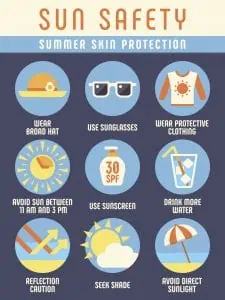
Sun Safety Infographic

Sun Safety

Summertime is fun time to spend outdoors. But in sunny Florida, that means more exposure to the sun’s ultraviolet (UV) rays. Those UV rays can damage unprotected skin in as little as 15 minutes and even lead to skin cancer. Here are some tips to keep you sun safe all year long.

Seek Shade

One of the easiest ways to reduce your exposure to damaging UV rays is to get in the shade. Seek shade under a tree, umbrella or another shelter in order to reduce your risk of sun damage. You’ll help your skin look younger longer and lower your risk of developing skin cancer.

Protective Clothing

Cover up with long-sleeved shirts and long pants when you can to protect your skin from the sun’s harsh UV rays. There are clothing options available that contain a UV protectant built into the fabric. Also, remember that a wet t-shirt provides less UV protection than a dry one, and darker colored clothing protects better than light-colored clothing. Don’t forget to top it off with a hat with a brim all the way around that shades your face, ears, and back of the neck. If you choose a baseball cap instead, be sure to protect your ears and the back of your neck with sunscreen of at least 30 SPF.

Sunglasses

Choose sunglasses that are labeled UV protectant to reduce the risk of developing cataracts. Most of the sunglasses sold in the U.S. block both UVA and UVB rays. Sunglasses also protect the skin around your eyes from sun damage, and wrap-around sunglasses are an excellent option to block UV rays that might sneak in from the side.

Wear Sunscreen

Choosing the right sunscreen can be daunting, so we recommend following these four rules to make it easier:

  1. Broad-spectrum – Broad-spectrum sunscreen protects the skin from both ultraviolet A (also known as UVA) and ultraviolet B (also known as UVB) rays. Both of these rays can cause skin cancer.
  2. SPF 30 or higher – The sun protection factor (SPF) rating indicates how well a sunscreen protects you from the sun by blocking harmful UVB rays. Choose a sunscreen with SPF 30 or higher to make sure you are protected.
  3. Key ingredients – Look for active ingredients like ecamsule, avobenzone, titanium dioxide, sulisobenzone or zinc oxide. Beware of products that include oxybenzone or octinoxate which are harmful to the environment. Some areas of Florida have banned the sale of sunscreen with oxybenzone and octinoxate because these chemicals can damage coral reefs.
  4. Avoid tanning oils – They generally do not provide enough protection against the harmful effects of the sun.

How to Apply Sunscreen & How Often

To get the maximum protection from your sunscreen, follow these recommendations:

  • One ounce of sunscreen is considered the right amount. Cover all exposed areas of the body thoroughly. Don’t skimp. Many people don’t use enough sunscreen.
  • Apply sunscreen 15 to 30 minutes before going in the sun. Don’t forget the tips of the ears, feet, back of the legs and bald spot (if you have one). Reapply sunscreen every two hours and use a UV-protective lip balm to cover your lips.
  • If you are exercising or are in the water, it’s a good idea to get a sunscreen that is resistant to water and sweat. The FDA defines water resistant to mean that the SPF level stays effective after 40 minutes in the water. Very water-resistant means it is effective after 80 minutes of swimming. These sunscreens are not waterproof, so reapply regularly.

Protecting your skin from the harmful rays of the sun can help you look younger and prevent skin cancer. Just to be on the safe side, be sure to get a skin cancer screening every year, so if you do develop skin cancer, it can be detected and treated early.

Schedule a skin cancer screening at your nearest Water’s Edge Dermatology office.


Young women tanning on a beach.

Tanning Safety & Skin Cancer Risk for Young Women

Ask most young women if appearing tanned is important to looking and feeling their best, and the answer will often be yes. Simply put, many still perceive a tanned face as a sign of health and attractiveness. It's a long-standing, common  perception that still motivates millions to hit the beach and/or tanning salon, searching for that sun-kissed look. That means we need to do all we can to increase understanding of tanning safety.

Exposure to sunlight and indoor tanning means exposure to damaging UV rays, proven to be the leading cause of skin cancer. The bottom line is, young ladies still pursuing a tan via UV light are at significantly higher risk of getting skin cancer later in life.

Tanning Safety Facts & Figures

As the popularity of the “tanned look” continues, so does the rise in skin cancer cases among young women. Statistics show that more people develop melanoma from tanning than those who develop lung cancer from smoking. And current data from the Skin Cancer Foundation reveals that more than 419,000 cases of skin cancer in the USA are related to indoor tanning.

In fact, anyone under the age of 35 using tanning beds increases their risk of melanoma, the deadliest form of skin cancer, by 75 percent. This has prompted several states to restrict people under age 18 from patronizing businesses and using devices related to indoor UV tanning.

Prevention

Evidently, one effective way for you to prevent skin cancer is by avoiding tanning beds. Usage of them is in fact the leading cause of melanoma in the USA. And because younger women tend to be out in the sun more, here are other tips to keep the UV rays at bay:

  • Apply and regularly reapply (every 80-90 minutes) sunscreen with SPF 30 or higher whenever out in sun.
  • Start carrying other tanning safety essentials in a bag you leave in your car, or can carry in a shoulder bags items  – such as a wide-brim hat, lightweight and long-sleeved shirt and pants, sunglasses, and an umbrella.
  • Be sure to schedule a full-body skin exam at the dermatologist’s office at least once a year, more if you and/or your family has a history of skin cancer.

ABCDEs of Melanoma

In between dermatologist skin screenings, it’s important to track the status of any moles and skin spots you may have, especially new ones. You can do that with regular self-exams (or you and your significant other can examine one another), using the simple ABCDE system to look for any of the following characteristics:

  • Asymmetrical moles or those with irregular shapes
  • Blurry border or jagged edges
  • Color not even
  • Diameter larger than a pencil eraser
  • Evolving or changing moles after weeks, months, or years

If the ABCDEs don't apply to your moles, good news! You may still want to explore paying to have  a mole removed, but it likely isn't a health concern. However should any of the above characteristics be found, it’s time to play it safe and find a great dermatologist in Avon Park, Jensen Beach, Lighthouse Point, or any other Florida city you happen to call home.

Getting the tanned look – safely

While being tanned may be an undying – or just a slowly dying -- beauty trend that you choose to follow…that doesn’t mean you have to rely on UV rays to do so. The selection of safe, indoor tanning creams and sprays just keeps getting bigger and better. So, if you want that tan…consider getting it from a can (or jar, bottle…you get the point)!

Call Water’s Edge Dermatology at (877) 900-3223 today, or request an appointment online.


Young girl examining arm for skin conditions

Top 5 Causes of Children's School Year Skin Problems

When summer officially ends every late September, the somewhat stressful “Back-to-School” season is also pretty much over with – whew! The question is, did shopping for school supplies and other preparations also leave you well-prepared for dealing with inevitable school year skin problems?

Below are 5 of the most common causes of skin problems among schoolchildren, plus some practical skincare tips on how to prevent or treat them.

Stress

It’s remarkable how much stress affects the skin.  Various rashes and acne are commonly caused by stress.  So what can you do to help minimize the impact of stress on your children's skin?  Find the right tools and techniques to keep their stress levels low (easier said than done, but think communication, exercise & relaxation). Ensure they gently wash their face twice daily with a mild, natural cleanser and warm rather than hot water. And get them to use a hypoallergenic, lightweight moisturizer (with SPF 30 or higher sun protection) daily.

Hormones

Hormones can play a huge role in causing acne for teens, and for an increasing numbers of "tweens" too.  Getting your schoolkids into a consistent daily facial cleansing and skincare routine is extremely important.  Visiting a dermatologist for the right acne treatment will be warranted in some cases. In extreme instances, you may also want to ask your family physician if hormone therapy is worth consideration.

Sweat

Let’s face it. Here in South Florida, everyone sweats, which can cause rashes and acne breakouts.  Training your children to seek shade outside and stay as dry as possible can help. Same with washing off sweat as soon as possible. Consider adding gentle, individually wrapped facial wipes, a lightweight, comfy cap or hat and a soft, absorbent washcloth or bandana to their daily backpack load. But remember to put that bandana in a baggie to keep it clean, and replace with a clean, dry one each day!

Sports

Autumn sports such as football can cause their own set of skin conditions. In Florida, there’s still the sun and heat causing heavy sweating. And sports helmets can cause folliculitis (inflammation of hair follicles).  Washing the face immediately after sports activity and cleaning helmet pads with rubbing alcohol are good preventive measures. Some sports uniforms and gear can also cause allergic reactions to some kids. If skin irritations develop in weeks after donning uniforms, a trip to your nearest Water’s Edge Dermatology office is in order.

Shoes/Clothing

Switching from summer’s tank-tops, shorts, and flip-flops to shoes, sneakers, and school uniforms can trigger common skin conditions, such as athlete’s foot. Breathable socks that wick away moisture from damp feet and over-the-counter foot powders that do the same can help prevent such fungal skin infections. New school uniforms should always be washed before first wearing, and if possible, given a day of “test-wearing” to identify any possible irritation or allergic reaction.

Of course, getting the kids on board with a program that addresses the 5 issues above can be…challenging.  Explain to them that getting and keeping the clear skin they crave is the goal, the reason for all the extra efforts. Putting sticky notes on bathroom/bedroom mirrors at home with gentle and/or humorous reminders can also help. And if/when needed, virtually all of our dermatology providers specialize in pediatric dermatology as well as adult skincare.

For questions on common school year skin conditions affecting children, such as skin rashes, skin infections and head lice, please contact Water’s Edge Dermatology for an appointment with one of our practitioners by calling your local office, or toll-free at (877) 900-3223. You can also request an appointment online.

Here's to you and your children having a happy, healthy school year!


The Difference between Drug Store Sunscreen and EltaMD Products

Most people with acne, rosacea and sensitive skin have challenges with sunscreens because of the ingredients added to them. Zinc oxide and titanium oxide are what you want in a sunscreen for long and short UVA/UVB protection. Most products that offer this kind of protection are not aesthetically pleasing.

Top 4 Reasons to choose EltaMD over a drug store product:

  1. EltaMD offers clear protection with antioxidants for additional protection.
  2. All of the EltaMD sunscreen have the highest possible protection from UVA and UVB rays with the safest natural materials. They avoid using harmful chemicals that can lead to irritation, damage the skin or penetrate the skin & are safe on children.
  3. EltaMD sunscreens are formulated with transparent zinc oxide and are noncomedogenic, sensitivity-free, fragrance-free and paraben-free & provide antioxidant protection.
  4. EltaMD products do not contain oxybenzone or avobenzone.

What are the top five reasons I believe everyone should wear sunscreen?

  1. The ozone layer is depleting and your body needs shielding from harmful rays.
  2. Skin Cancer rates are on the rise and sunscreen has been proven to decrease the development of skin cancer.
  3.  It helps to prevent facial brown spots and skin discolorations.
  4.  It also helps to reduce the appearance of facial red veins and blotchiness.
  5.  It slows down the development of wrinkled, premature aging skin.

Water's Edge Dermatology logo

Don't Spray Sunscreen on Kids ... At Least for Now

The Food and Drug Administration announced last month that it was investigating the potential risks of spray sunscreens. Of particular concern to us is the possibility that people might accidentally breathe in the ingredients, a risk that’s greatest in children, who—as any parent knows—are more likely to squirm around when they’re being sprayed.

As a result, we now say that until the FDA completes its analysis, the products should generally not be used by or on children. We have also removed one sunscreen spray—Ocean Potion Kids Instant Dry Mist SPF 50—from the group of recommended sunscreens in our sunscreen Ratings, because it is marketed especially for children.

Finally, we would like to reemphasize our longstanding advice that you use sprays carefully, by following these tips:

• Don’t use sprays on children, unless you have no other product available. In that case, spray the sunscreen onto your hands and rub it on. As with all sunscreens, be especially careful on the face, taking care to avoid the eyes and mouth.

• Adults can still use sprays—but don’t spray your face! Instead, spray on your hands and rub it on, making sure to avoid your eyes and mouth. And try to avoid inhaling it.

• Make sure you apply enough. Our tests have found that sprays can work well when used properly—but it is harder to make sure that you apply enough, especially when it’s windy. We recommend spraying as much as can be evenly applied, and then repeating, just to be safe. On windy days, you might want to spray the sunscreen on your hands and rub it on—or just choose one of our recommended lotions instead.

This entry was shared from Consumer Reports. 


Water's Edge Dermatology logo

Effective Sunburn Treatment

If you got a nasty sunburn recently, here are some treatment options, as well as tips to prevent future burns and a warning about the dangers of catching too many rays.

We love this great video as a quick refresher.

Sunburn treatment

The Skin Cancer Foundation recommends these five steps to treat a sunburn:

  1. Don’t wait to treat. A sunburn can take some time to develop, so you should get out of the sun and follow steps 2-5 as soon as possible if you feel a sunburn coming on.
  2. Moisturize and repeat. Use a cream or lotion to soothe your burn, and to help prevent peeling. You’ve probably heard that aloe vera is a good treatment for sunburn, and although initial research has shown only that aloe may help heal burns, at the very least, it will soothe the burn’s heat and pain.
  3. Drink lots of water. One side effect of a sunburn is that the fluid in your body is drawn to the surface, to your skin. To make sure you don’t get dehydrated, drink plenty of water.
  4. Take an anti-inflammatory. Ibuprofen can help to reduce swelling and redness if taken as soon as you feel the burn coming on.
  5. Seek medical help if necessary. If you’re experiencing bad blistering, fever or chills, seek the help of a medical professional.

Adult Acne Treatment

Treating Adult Acne

Acne is frequently considered a skin disorder of adolescents and teens. Unfortunately, acne can affect adults in their 20s, 30s and beyond. Many factors can contribute to the appearance of acne, including hormones, disorders of the hair follicles and infections. While there is no cure for acne, there are many effective ways to control and treat adult acne.

Adult acne can be divided in two groups of patients. The common acne in children can also occur in an adult, which is known as acne vulgaris. Another form of adult acne is known as acne rosacea. Acne rosacea is commonly recognized by the inflammation and redness of the face, but most often lacks the appearance of blackheads or open comedones.

Acne can be controlled with over-the-counter products as well as prescription medications. Establishing a skin care regimen with a dermatology provider can be very helpful in treating acne. Many treatments are available, including cleansers, topical treatment, oral antibiotic therapy, oral isotretinoin courses and even blue light therapy.

Starting with a mild antibacterial cleanser or benzoyl peroxide wash twice daily keeps the face and body clean and keeps oil to a minimum. Do not scrub the face and body clean as friction can increase the acne lesions.

Prescription treatments available for acne can be topical creams, gels or solutions. The topical medications can include one or more medications. Topical medications should be used consistently and as prescribed by your provider for best results. Topical treatments can be drying, so it is important to speak with your provider about adding a moisturizer or decreasing the frequency of use if this occurs.

Oral antibiotics can be used to treat acne and acne rosacea in adult patients. Oral antibiotic therapy can be given for short-term or long-term treatments, depending on the response to treatment and the medication prescribed by your provider. Low dose, long-term antibiotic therapy is available and effective for many patients.

Oral Isotretinoin is an option for severe acne. It was previously marketed under the name Accutane but is available now in generic forms. This particular medication is available if other oral medications have failed. Isotretinoin is closely monitored by a program called iPledge. Blood work is monitored each month by your provider. Two forms of birth control must be in place for female patients as this medication can cause birth defects if pregnancy occurs during the time period the medication is being administered. This medication is generally given for a course of four to six months.

The most important key to the management of acne is to be consistent with your use of medication. Consistency is important.

Finally, even acne prone skin needs sunscreen each day. Finding a sunscreen that is oil-free and non-comedogenic is important. Please visit a Water’s Edge office for Elta MD Shield, which is a zinc sunscreen that is lightweight, absorbs completely and is great for oily skin types.

References: Acne (n.d.) American Osteopathic College of Dermatology. Retrieved from www.aocd.org.


Woman applying sunscreen to her face.

The Long and Short of UV rays

Coolers, beach chairs, umbrellas and sunscreen, lots of sunscreen, are popping up in endless colorful displays throughout stores nationwide! This could only mean one thing, summer is on the horizon!

Picking out a sunscreen to protect yourself and your family can be a bit confusing. What brand do I want? What spf do I need? What does UVA and UVB protectants even mean?

Let's start with the basics...

Ultraviolet UV rays are emitted from the sun in three lengths. UVA are the long rays, UVB are the short rays and UVC are absorbed in the ozone layer before they even make it to earth. Over the years research has shown that both UVA and UVB can cause damage to the skin. These rays are proven human carcinogens which means they can cause genetic mutations in the skin leading to skin cancers.

UVA rays are the long rays which can penetrate their way deeper into the skin and are responsible for skin aging and wrinkling. They are present during all daylight hours and remain even throughout the year. The tilt of the earth during various seasons does not change the level of UVA rays found in sunlight. These UVA rays can penetrate clouds and even glass when you are indoors or in your car. As you can see, the recommendation of daily sunscreen as part of a good skin care regimen is important.

UVA rays are responsible for damaging the keratinocytes which are found in the basal layer of the epidermis. Basal cells and squamous cells are both types of keratinocytes. Damage to these cells can lead to to both basal cell carcinoma and/or squamous cell carcinoma which are the first and second most common forms of skin cancer.

UVB are the short rays which penetrate and damage the more superficial layers of the skin known as the epidermal layers. These short rays are responsible for burning and reddening of the skin. The intensity of the UVB rays varies with season, location and time of day. UVB rays are most intense between the hours of 10am to 4pm from April through October. Avoidance of the sun during these peak hours is an effective way to prevent skin damage. Although at higher altitudes and with reflection on ice or snow, UVB rays can cause damage throughtout the year. In contrast to UVA, UVB do not significanlty pass through glass.

Protection is Key!

Now that we know both UVA and UVB rays can cause long lasting skin damage what do we do? Protecting yourself and your family is your primary prevention. Hats, sunglasses, sunscreen and sun protective clothing are key. When choosing a sunscreen read carefully, select a product with "broad-spectrum" coverage for both UVA/UVB protection with as spf of 30 or higher!

Please stay tuned for our second part of sun protection....Choosing Sunscreen, Mineral vs Chemical?

Reference: www.skincancer.org, 2013 The Skin Cancer Foundation | 149 Madison Avenue Suite 901 New York, New York


Sunscreen: Your questions answered

Water's Edge Dermatology providing skin cancer and sunscreen awareness to UPS drivers.